Hiring process flowchart (recruitment swimlane)
This hiring process flowchart is a recruitment swimlane. It shows how a candidate moves from application to accepted offer across four roles: Candidate, HR, Interviewer and Hiring Manager. It is built for HR, operations and team leads who need to document who owns each step and where the hand-offs happen.
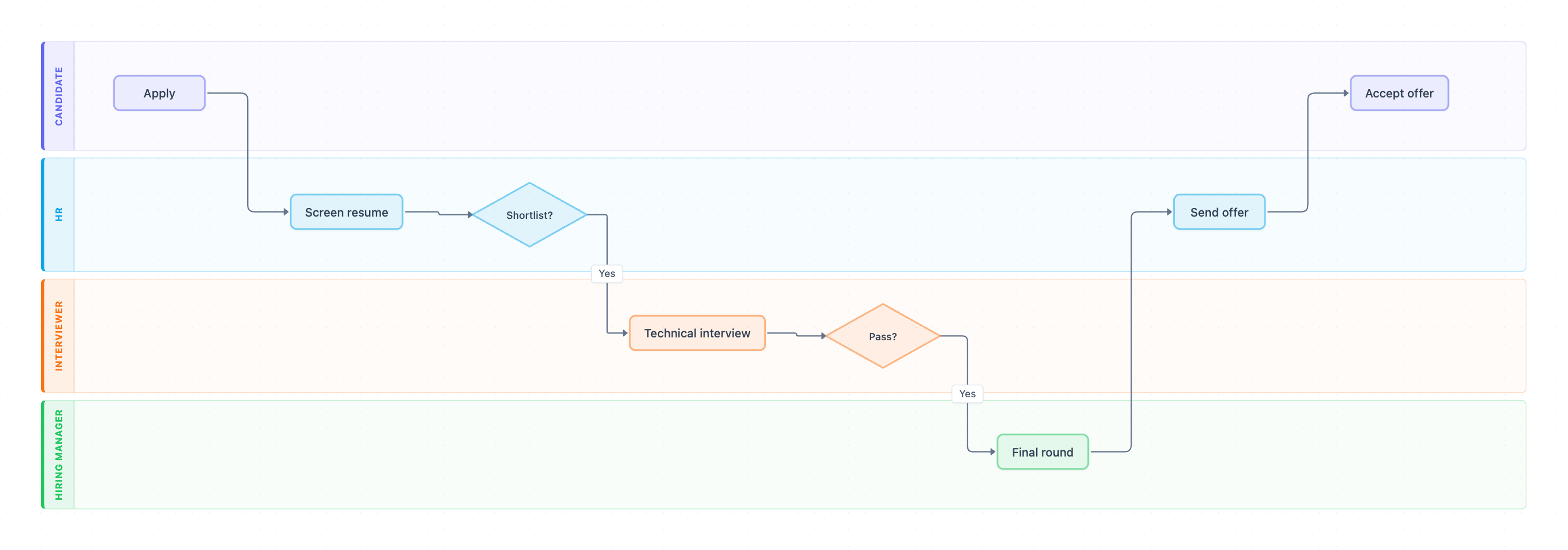
Example: Swimlane diagram for the hiring process: click to open it in the editor and change it.
Lanes and steps in order
- Apply (Candidate): The candidate submits an application. This is the first hand-off, to HR.
- Screen resume (HR): HR reviews the application.
- Shortlist? (HR, decision): If the answer is Yes, the candidate is handed off to the Interviewer lane.
- Technical interview (Interviewer): The interviewer assesses the candidate's skills.
- Pass? (Interviewer, decision): If the answer is Yes, the candidate is handed off to the Hiring Manager.
- Final round (Hiring Manager): The hiring manager runs the last interview. Then the process hands back to HR.
- Send offer (HR): HR issues the offer to the candidate.
- Accept offer (Candidate): The candidate accepts, and the flow ends.
Hand-offs and decision points
The flow crosses lanes five times: Candidate → HR → Interviewer → Hiring Manager → HR → Candidate. There are two decisions, Shortlist? and Pass?. Only their Yes paths are drawn. The diagram does not show what happens on No, or when a candidate declines the offer.
Where this process usually slows down
- Screen resume: Applications pile up when HR has no screening SLA.
- Between Pass? and Final round: Scheduling the hiring manager's time is a common bottleneck.
- Between Final round and Send offer: Delays happen when nobody clearly owns the hand-back to HR.
How to adapt it for your project
- Rename lanes to match your company's roles, such as Recruiter, Panel or Department Head.
- Add No branches from Shortlist? and Pass? to a rejection step, so these exceptions have an owner.
- Insert an offer approval step before Send offer if pay above a set limit needs sign-off from Finance or a VP.
- Add a branch for a declined offer after Send offer.
- Note an SLA next to each hand-off so you can measure cycle time.
Tip: Open and edit it, then label each cross-lane arrow with its owner and target turnaround time. Hand-offs are where most hiring delays hide.
Standard operating procedure
Purpose: Run every hire the same fair, documented way, from application to accepted offer.
Scope: Starts when a candidate applies to an open role. Ends when the offer is accepted, or the candidate is turned down.
Roles
- HR: Screens resumes, shortlists and sends the offer.
- Interviewer: Runs the technical interview and scores it.
- Hiring manager: Runs the final round and makes the hiring decision.
Procedure
- HR: Screen each new application against the job requirements within 3 business days.
- HR: Decide whether to shortlist. If yes, book the technical interview. If no, send a polite decline.
- Interviewer: Run the technical interview and submit a scorecard within 24 hours.
- Interviewer: Recommend pass or fail. On a pass, hand the candidate to the hiring manager.
- Hiring manager: Run the final round and confirm the hire, level and salary with HR.
- HR: Send the written offer and confirm acceptance with the candidate.
Process owner: Head of Talent
Turn this into a full SOP with AI →
Frequently asked questions
What are the swimlanes in a hiring process flowchart?
This diagram uses four lanes: Candidate, HR, Interviewer and Hiring Manager. Each lane owns specific steps, such as HR owning Screen resume and Send offer.
What decision points are in the hiring process?
There are two: Shortlist?, owned by HR after resume screening, and Pass?, owned by the Interviewer after the technical interview. Both continue the flow on Yes.
Where should offer approval go in a recruitment flowchart?
This diagram has no approval step. Most teams add one between Final round and Send offer, owned by Finance or a senior manager, based on their approval limits.
Make your own swimlane diagram with AI →