Retail store organizational chart
This retail store organizational chart shows one **Store Manager** leading three teams: the sales floor, stock and the cash office. Each team has its own lead and frontline staff. It is meant for operations, HR and finance managers who need to document who owns what in a store and where escalations and approvals go.
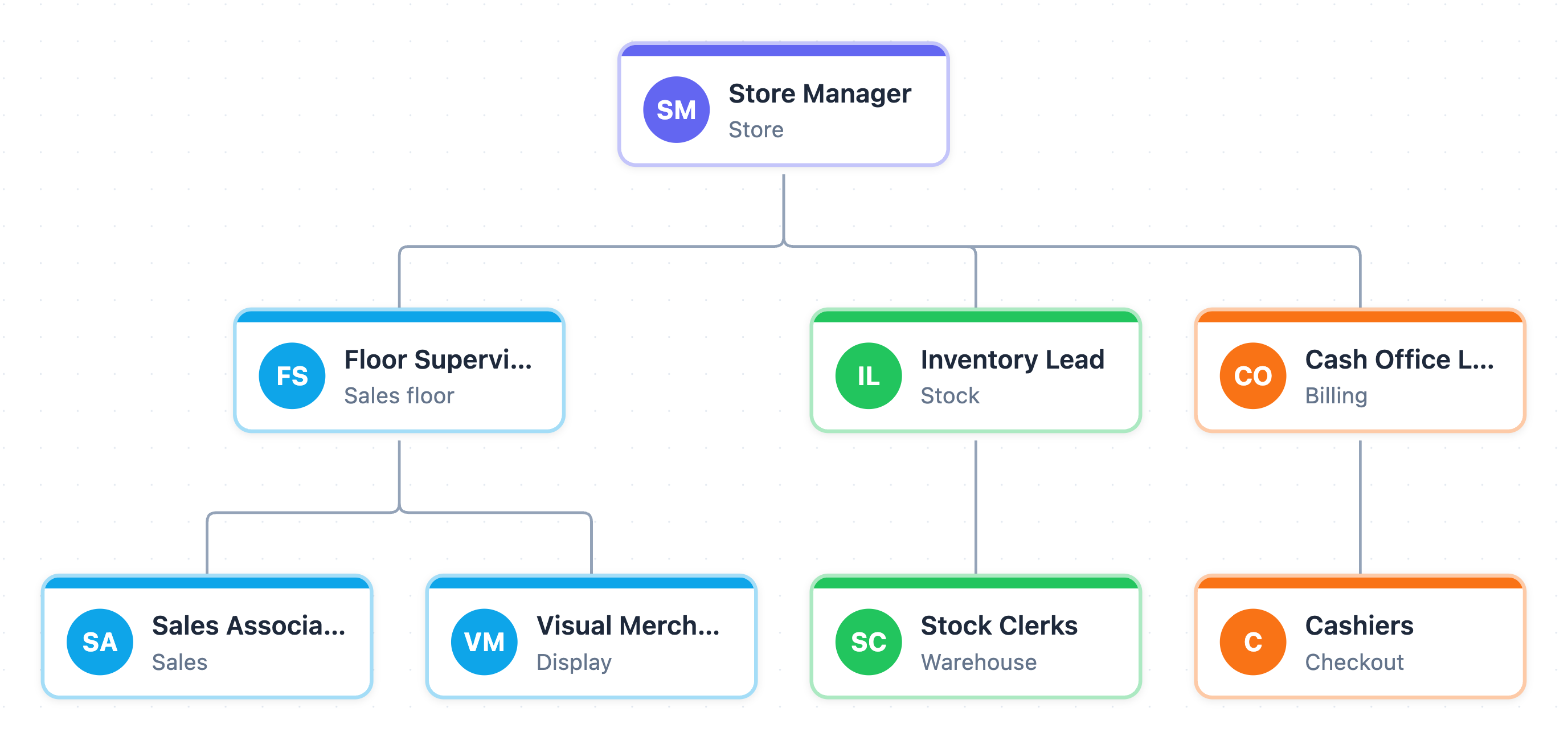
Example: Org chart for a retail store: click to open it in the editor and change it.
The roles and reporting lines
| Team | Lead (reports to Store Manager) | Direct reports |
|---|---|---|
| Sales floor | Floor Supervisor | Sales Associates, Visual Merchandiser |
| Stock | Inventory Lead | Stock Clerks (Warehouse) |
| Billing | Cash Office Lead | Cashiers (Checkout) |
The Store Manager is the single owner at the top and has three direct reports. Every frontline role reports to exactly one lead, so each person has one clear manager for scheduling, approvals and exceptions.
Hand-offs and decision points
- Floor Supervisor: decides between selling priorities (Sales Associates) and display work (Visual Merchandiser).
- Inventory Lead: owns stock decisions and directs Stock Clerks. Products move from the warehouse to the sales floor at the hand-off between the stock team and the sales floor team.
- Cash Office Lead: owns billing and handles checkout exceptions raised by Cashiers.
- Store Manager: the only point where all three teams meet, so cross-team conflicts escalate here.
Where this process usually slows down
The chart has no direct line between teams. If Sales Associates need a restock or Cashiers hit a pricing exception, the request often travels up to a lead, sometimes up to the Store Manager, and back down again. That shared approver can become a bottleneck at peak hours. The Visual Merchandiser also depends on stock from a different team, which can delay display changes.
How to adapt it for your project
- Rename the roles to match your company's job titles and add any missing lead, such as an assistant manager.
- Write each lead's approval limits next to their box, for example refund amounts or markdown authority.
- Add dotted lines or notes for routine cross-team hand-offs so they don't always escalate to the Store Manager.
- Record headcount or shift coverage under each frontline role.
Tip: Open and edit it, then keep the color coding (indigo, blue, green, orange) so each team stays easy to spot when you add roles.
Frequently asked questions
Who reports to the Store Manager in a retail store org chart?
In this chart, three leads report to the Store Manager: the Floor Supervisor, the Inventory Lead and the Cash Office Lead. All frontline staff report through one of these leads.
How many levels does a retail store organizational chart have?
This one has three levels. The Store Manager is at the top, the team leads are in the middle, and Sales Associates, the Visual Merchandiser, Stock Clerks and Cashiers are at the bottom.
Who does the Visual Merchandiser report to?
The Visual Merchandiser reports to the Floor Supervisor, alongside the Sales Associates. Display work therefore sits within the sales floor team.
Make your own org chart with AI →