Data structures mind map (revision)
This mind map puts **Data Structures** at the centre and splits it into five branches: Linear, Trees, Graphs, Hashing and Sorting. It is built for students revising for exams or interviews who want to see the whole topic on one page.
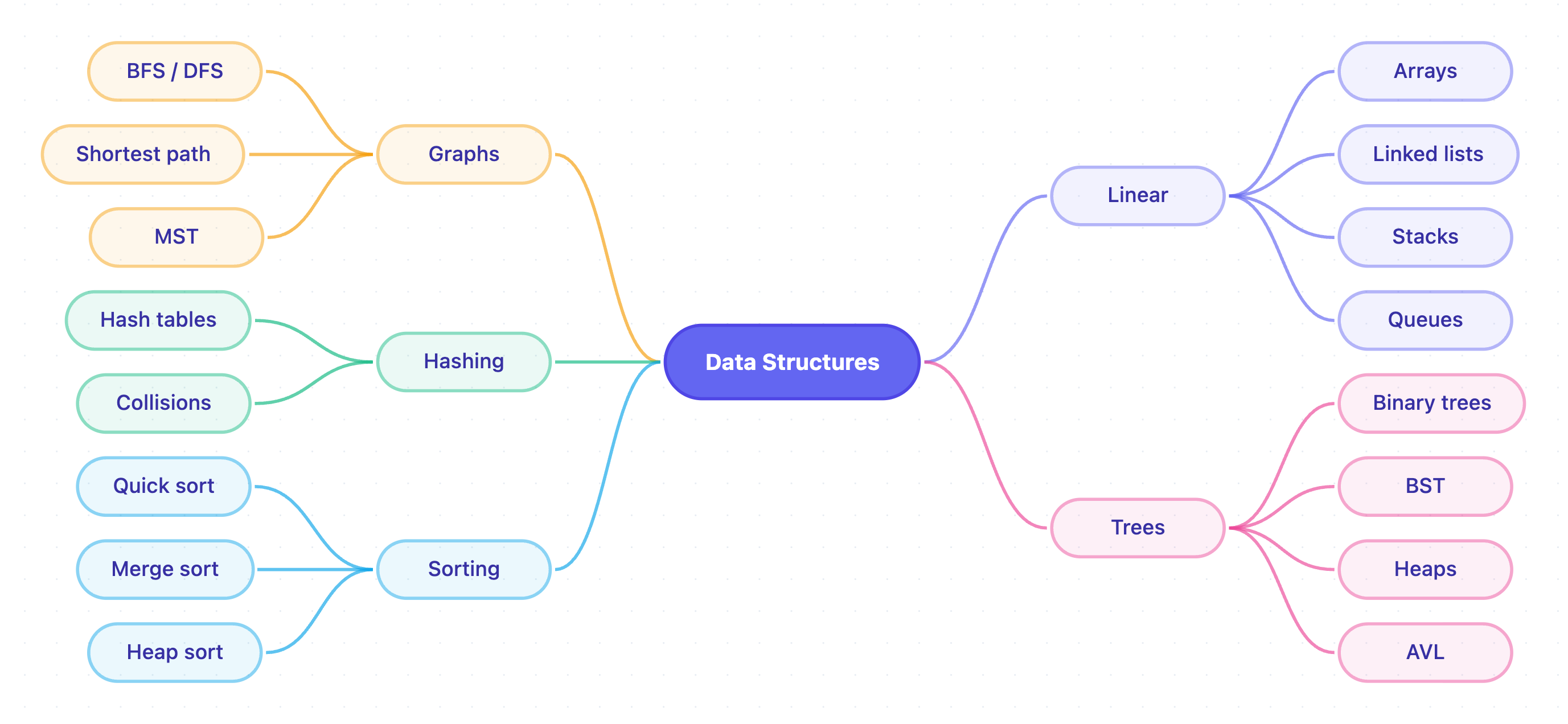
Example: Mind map for data structures revision: click to open it in the editor and change it.
The five branches
Each branch from the root Data Structures is a main topic, and its leaves are the subtopics to revise.
| Branch | Subtopics | What to revise |
|---|---|---|
| Linear | Arrays, Linked lists, Stacks, Queues | Elements stored in sequence. Know index access compared with pointer links, and LIFO (stacks) compared with FIFO (queues). |
| Trees | Binary trees, BST, Heaps, AVL | Hierarchical structures. Know the BST ordering rule, the heap property and how AVL trees stay balanced. |
| Graphs | BFS / DFS, Shortest path, MST | Nodes and edges. Revise traversal order, shortest-path problems and minimum spanning trees. |
| Hashing | Hash tables, Collisions | Key-to-index mapping. Know how collisions happen and the common ways to resolve them. |
| Sorting | Quick sort, Merge sort, Heap sort | Ordering algorithms. Compare their time complexity, stability and extra memory use. |
Links between branches
- Heaps under Trees are the structure behind Heap sort under Sorting.
- Stacks and Queues from the Linear branch power BFS / DFS. DFS uses a stack and BFS uses a queue.
- Arrays sit underneath Hash tables and are the input for every sorting algorithm on the map.
How to adapt it for your project
- Open and edit it, then add a third level under each leaf, such as time complexity for Quick sort or operations for Stacks.
- Add branches your course covers, for example Tries under Trees or Linear probing and Chaining under Collisions.
- Remove leaves your syllabus skips so the map matches your exam.
- Colour-code leaves by confidence (known, shaky, not started) to plan your revision sessions.
Tip: Use the map for active recall. Hide one branch, try to write its leaves and key facts from memory, then check against the diagram.
Frequently asked questions
What topics are in a data structures mind map?
This map covers five branches: Linear (arrays, linked lists, stacks, queues), Trees (binary trees, BST, heaps, AVL), Graphs (BFS/DFS, shortest path, MST), Hashing (hash tables, collisions) and Sorting (quick, merge and heap sort).
How many levels does this data structures mind map have?
It has three levels: the root Data Structures, five main branches, and 16 leaf subtopics. You can add a fourth level for complexities or examples.
Why is sorting included in a data structures mind map?
Sorting algorithms are usually taught and examined alongside data structures. Heap sort, for example, depends directly on the heap structure from the Trees branch.
Make your own mind map with AI →