SWOT analysis mind map template
This mind map lays out a SWOT analysis as a central **SWOT** node with four branches: **Strengths**, **Weaknesses**, **Opportunities** and **Threats**. Each branch holds two example factors, such as **Strong brand** and **Regulation**. It suits students learning strategic planning and teams who want a quick visual starting point for their own analysis.
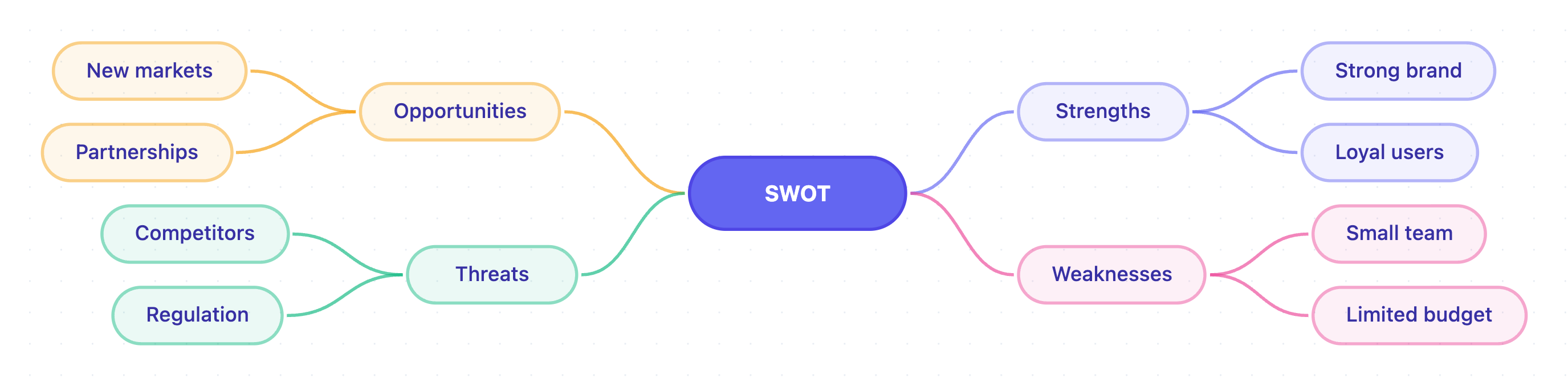
Example: Mind map for a SWOT analysis: click to open it in the editor and change it.
How the mind map is structured
The diagram has three levels. The root node SWOT sits in the centre. Four category branches grow from it, and each category has two leaf nodes with concrete factors. That gives 13 nodes in total: 1 root, 4 categories and 8 factors.
| Branch | Type | Example factors |
|---|---|---|
| Strengths | Internal, helpful | Strong brand, Loyal users |
| Weaknesses | Internal, harmful | Small team, Limited budget |
| Opportunities | External, helpful | New markets, Partnerships |
| Threats | External, harmful | Competitors, Regulation |
What each branch means
- Strengths are advantages the organisation already controls. A Strong brand and Loyal users give it a solid base to build on.
- Weaknesses are internal limits. A Small team and Limited budget restrict how much it can do at once.
- Opportunities come from outside. New markets and Partnerships are chances to grow if the organisation acts on them.
- Threats are outside risks. Competitors and Regulation could reduce growth or add costs.
Reading across branches helps with planning. For example, Loyal users (a strength) could help a company enter New markets (an opportunity). Partnerships might make up for a Limited budget.
How to adapt it for your project
- Open and edit the diagram, then rename the root SWOT node to your project, product or company name.
- Replace the eight example leaves with your own factors. Keep each label short, using two to four words.
- Add more leaves under any branch where you have more points. Delete a leaf if it doesn't apply.
- Check each factor is in the right branch. Things you control go under Strengths or Weaknesses. Outside forces go under Opportunities or Threats.
Tip: A common mistake is listing an opportunity as a strength. Ask "Do we control this?" If the answer is no, it belongs in Opportunities or Threats.
Frequently asked questions
What are the four parts of a SWOT analysis mind map?
The four branches are **Strengths**, **Weaknesses**, **Opportunities** and **Threats**. They all connect to a central **SWOT** node. In this template, each branch has two example factors.
Which SWOT factors are internal and which are external?
Strengths and Weaknesses are internal, like **Small team** or **Strong brand**. Opportunities and Threats are external, like **New markets** or **Regulation**.
Why use a mind map instead of a SWOT grid?
A mind map makes it easy to add or remove factors under each branch without running out of space. It also works well for brainstorming before you finalise a classic 2×2 grid.
Make your own mind map with AI →