Machine learning mind map (key concepts)
This mind map sorts the core ideas of machine learning into four branches around a central **Machine Learning** node. It suits students starting a course, developers reviewing the basics, and anyone who needs a one-page overview for revision or a presentation.
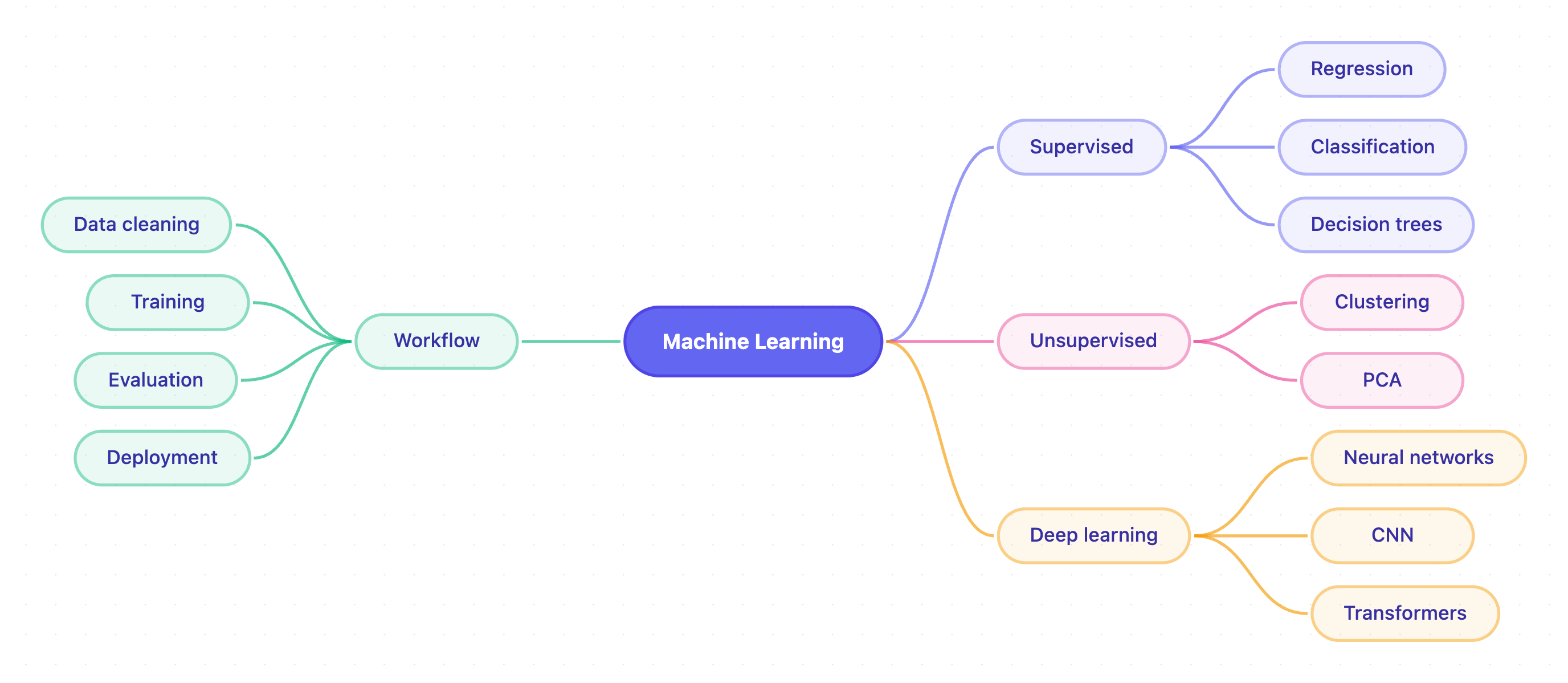
Example: Mind map for machine learning concepts: click to open it in the editor and change it.
The four main branches
The central node Machine Learning connects to four branches. Each branch holds a small set of related concepts, 12 in total.
| Branch | Concepts in the map | What ties them together |
|---|---|---|
| Supervised | Regression, Classification, Decision trees | Learning from labelled examples to predict a number or a category |
| Unsupervised | Clustering, PCA | Finding structure in data that has no labels |
| Deep learning | Neural networks, CNN, Transformers | Models built from many layers of neurons |
| Workflow | Data cleaning, Training, Evaluation, Deployment | The practical steps of an ML project |
How to read it
- Supervised groups two task types and one model family. Regression predicts values and Classification predicts classes. Decision trees can do either.
- Unsupervised pairs Clustering, which groups similar points, with PCA, which reduces the number of features.
- Deep learning starts from Neural networks. CNN (good for images) and Transformers (good for text and sequences) are two specialised designs.
- Workflow reads in order: Data cleaning → Training → Evaluation → Deployment.
How to adapt it for your project
- Open and edit the diagram, then rename the root to fit your focus, such as "ML for my thesis".
- Add the leaves your course covers. For example, add more models under Supervised, or a step like feature engineering under Workflow.
- Add a fifth branch if you need one, such as reinforcement learning, so it sits next to the existing four.
- Add short notes to leaves, such as a metric under Evaluation or a library name under Training.
Tip: Keep each branch to five or fewer leaves. If a branch grows larger, split it into sub-branches so the map stays readable at a glance.
Frequently asked questions
What are the main branches of a machine learning mind map?
This map uses four branches: **Supervised**, **Unsupervised**, **Deep learning** and **Workflow**. Together they cover learning types, model families and project steps.
Where do decision trees fit in machine learning?
In this mind map, **Decision trees** sit under **Supervised** learning. They learn from labelled data and can handle both regression and classification.
What are the steps of a machine learning workflow?
The **Workflow** branch lists four steps in order: **Data cleaning**, **Training**, **Evaluation** and **Deployment**. Real projects often loop back from evaluation to training to improve the model.
Make your own mind map with AI →