Content approval process flowchart (marketing)
This content approval process flowchart shows how a blog post, email, ad or landing page moves from first draft to published. It has four lanes, **Writer**, **Editor**, **Legal & Brand** and **Marketing Manager**, and three review decisions that each send the draft back for revision. It is for marketing managers and content leads who want faster approvals without off-brand or risky content going live.
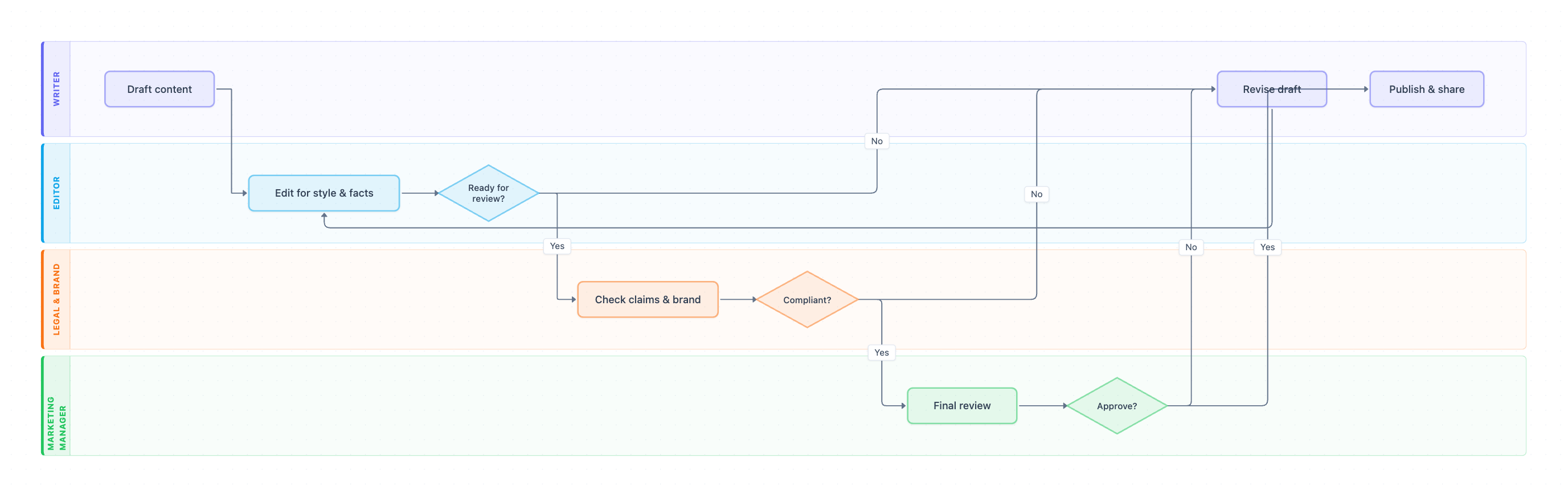
Example: Swimlane diagram for marketing content approval: click to open it in the editor and change it.
Lanes and steps in order
- Draft content (Writer): the writer drafts the piece from the brief.
- Edit for style & facts (Editor): the editor checks clarity, tone, grammar and facts.
- Ready for review? (Editor, decision): Yes goes to Legal & Brand. No goes to Revise draft.
- Check claims & brand (Legal & Brand): checks product claims, pricing, trademarks, disclosures and brand guidelines.
- Compliant? (Legal & Brand, decision): Yes goes to the marketing manager. No goes back for revision.
- Final review (Marketing Manager): the manager checks it fits the campaign and goals.
- Approve? (Marketing Manager, decision): Yes goes to publishing. No goes back for revision.
- Revise draft (Writer): the writer makes the changes and sends the draft back to the editor.
- Publish & share (Writer): the approved piece goes live and is shared.
Hand-offs and decision points
Every No returns to Revise draft, and every revision goes back through the editor. That keeps one version of the draft and stops reviewers editing different copies.
Where this process usually slows down
- Check claims & brand: legal review is the slowest step. Agree which content types actually need it.
- Revise draft: feedback from three reviewers arrives at different times and conflicts.
- Final review: late changes from the manager restart the whole loop.
How to adapt it for your company
- Add a fast lane for low-risk content, such as social posts, that skips legal review.
- Add an SME or product review lane for technical content.
- Add a Schedule step with a publish date for campaigns.
- Set a review SLA for each lane, such as 2 business days.
Tip: Get the marketing manager to approve the brief before drafting starts. Most late rejections are really disagreements about the brief.
Standard operating procedure
Purpose: Publish accurate, on-brand and compliant content without slow, endless review loops.
Scope: Covers blog posts, emails, ads and landing pages. Starts with a draft and ends when it is published.
Roles
- Writer: Drafts, revises and publishes.
- Editor: Edits for style and facts.
- Legal & Brand: Checks claims and brand rules.
- Marketing Manager: Gives final sign-off.
Procedure
- Writer: Draft the content from an approved brief.
- Editor: Edit for clarity, style and facts within 2 business days. Return drafts that are not ready.
- Legal & Brand: Check claims, pricing, disclosures and brand rules. Return non-compliant drafts with comments.
- Marketing Manager: Give the final review and approve, or return with clear changes.
- Writer: Make all revisions in one version of the draft and send it back to the editor.
- Writer: Publish the approved content and share it on the planned channels.
Process owner: Content Marketing Manager
Turn this into a full SOP with AI →
Frequently asked questions
What is a content approval process?
The agreed steps a piece of content goes through before publishing: drafting, editing, legal and brand checks, and final sign-off.
Who should approve marketing content?
Usually an editor for quality, legal or brand for claims and compliance, and a marketing manager for the final sign-off. Low-risk content can skip some reviews.
How do I speed up content approvals?
Approve the brief first, set review SLAs, keep one version of the draft, and skip legal review for content types that don't need it.
Make your own swimlane diagram with AI →