Product return (RMA) process flowchart
This product return process flowchart shows a standard **RMA** (return merchandise authorization) process. A customer requests a return, gets an RMA number and label, ships the item back, and receives either a refund or a replacement. It has four lanes, **Customer**, **Customer Service**, **Warehouse** and **Finance**, and three decisions. It is for e-commerce, customer service and warehouse managers.
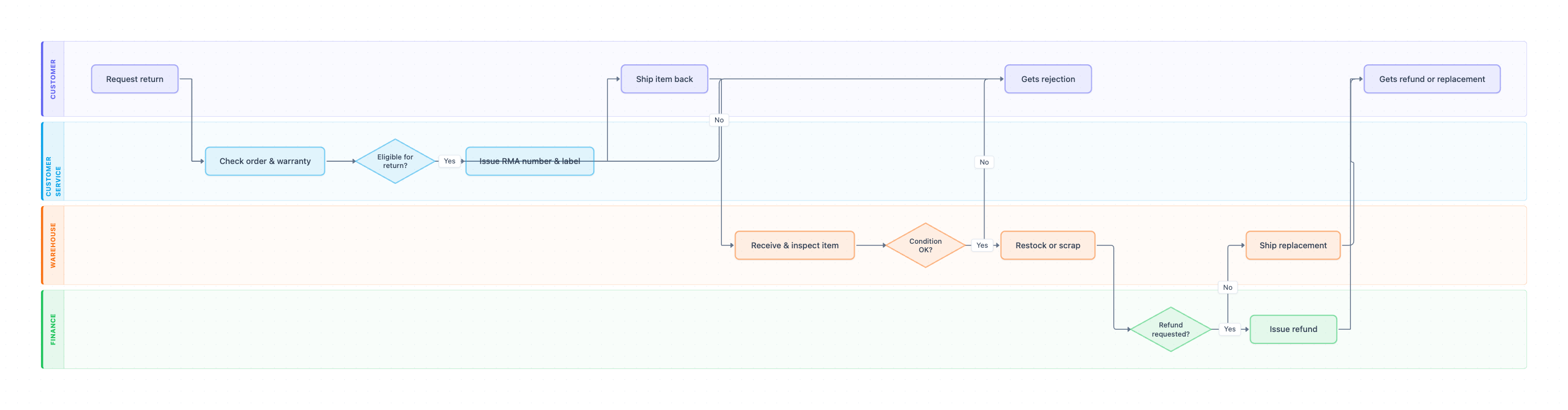
Example: Swimlane diagram for product returns (RMA): click to open it in the editor and change it.
Lanes and steps in order
- Request return (Customer): the customer asks to return a product.
- Check order & warranty (Customer Service): the agent checks the order date, return window and warranty.
- Eligible for return? (Customer Service, decision): Yes issues an RMA. No ends at Gets rejection.
- Issue RMA number & label (Customer Service): the customer gets an RMA number and a shipping label.
- Ship item back (Customer): the customer sends the item with the RMA number.
- Receive & inspect item (Warehouse): the warehouse matches the package to the RMA and inspects it.
- Condition OK? (Warehouse, decision): Yes continues. No ends at Gets rejection, often with the item sent back.
- Restock or scrap (Warehouse): the item goes back into stock, to refurbishment or to scrap.
- Refund requested? (Finance, decision): Yes goes to Issue refund. No goes to Ship replacement.
- Gets refund or replacement (Customer): the customer receives the outcome, and the RMA closes.
Hand-offs and decision points
The RMA number links every hand-off: Customer Service creates it, the customer writes it on the package, and the warehouse and Finance use it to find the case. Without it, returns arrive at the dock as unidentified packages.
Where this process usually slows down
- Receive & inspect item: returns are lower priority than outgoing orders, so they wait.
- Ship item back: packages arrive without an RMA number and can't be matched.
- Issue refund: Finance waits for the warehouse to confirm inspection.
How to adapt it for your company
- Add an advance replacement path for high-value customers, shipping the replacement before the return arrives.
- Add a repair path for warranty items instead of a refund or replacement.
- Add a restocking fee step for opened items if your policy has one.
- Track return reasons at Request return to find product quality issues.
Tip: Put the RMA number on the return label itself, not only in the email, so the warehouse can match every package.
Standard operating procedure
Purpose: Handle every product return under an RMA number, so each one is tracked to a refund, replacement or rejection.
Scope: Starts when a customer requests a return. Ends when they receive a refund or replacement, or are told the return is rejected.
Roles
- Customer Service: Checks eligibility and issues RMA numbers.
- Warehouse: Receives, inspects and restocks returns, and ships replacements.
- Finance: Issues refunds.
Procedure
- Customer Service: Check the order date, return window and warranty. Reject ineligible returns with the reason.
- Customer Service: Issue an RMA number and a return label showing it.
- Warehouse: Receive the package, match it to the RMA and inspect it within 2 business days.
- Warehouse: If the condition is not acceptable, tell Customer Service so the customer is informed.
- Warehouse: Restock, refurbish or scrap the item.
- Finance: Issue the refund if requested; otherwise the warehouse ships a replacement. Close the RMA.
Process owner: Customer Service Manager
Turn this into a full SOP with AI →
Frequently asked questions
What is an RMA process?
A return merchandise authorization process: the customer gets approval and an RMA number before sending a product back, so the return can be tracked and resolved.
What is the difference between a refund process and an RMA process?
A refund process is about returning money. An RMA process manages the physical return and can end in a refund, a replacement or a repair.
Who handles product returns?
Customer service approves the return, the warehouse receives and inspects the item, and Finance issues any refund.
Make your own swimlane diagram with AI →