Vendor onboarding process flow (BPMN)
This vendor onboarding process flow is a BPMN diagram for adding a new supplier safely. It runs from a team's request to an active vendor record, across four lanes: **Requester**, **Procurement**, **Vendor** and **Finance**. It includes a check for existing vendors, the documents a US company typically collects, a risk review and bank verification. It is for procurement, AP and operations managers.
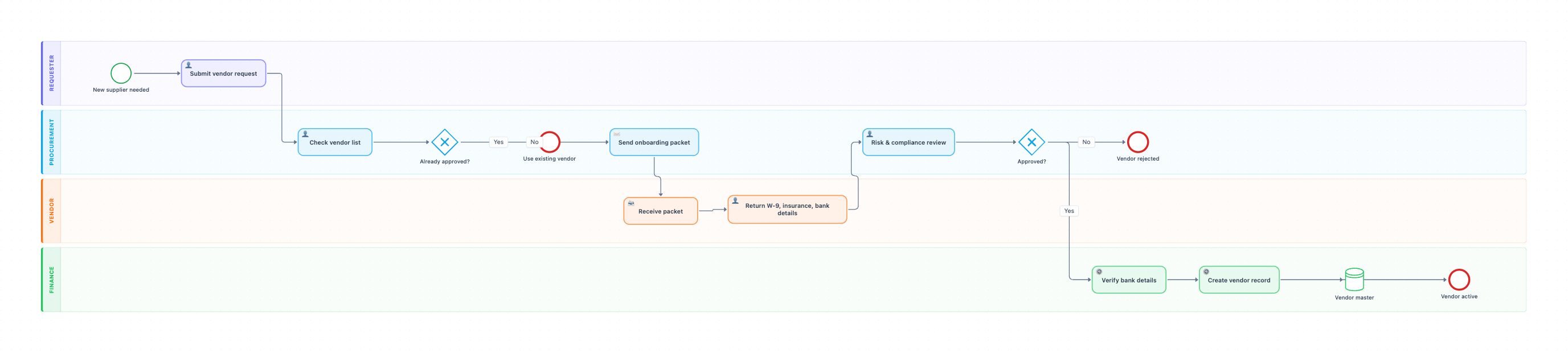
Example: BPMN diagram for vendor onboarding: click to open it in the editor and change it.
Lanes and steps in order
- New supplier needed (Requester, start event): a team needs to buy from a new supplier.
- Submit vendor request (Requester): the requester explains what is being bought and why this vendor.
- Check vendor list (Procurement): Procurement checks whether an approved vendor already supplies this.
- Already approved? (gateway): Yes ends at Use existing vendor. No continues.
- Send onboarding packet (Procurement): Procurement sends the vendor the forms to complete.
- Receive packet and Return W-9, insurance, bank details (Vendor): the vendor completes and returns them.
- Risk & compliance review (Procurement): checks sanctions lists, insurance limits, security or data questions and contract terms.
- Approved? (gateway): Yes goes to Finance. No ends at Vendor rejected.
- Verify bank details (Finance): Finance confirms the bank account by a call-back to a known number.
- Create vendor record (Finance): Finance adds the vendor to the Vendor master, and the vendor is active.
Hand-offs and decision points
The first gateway stops duplicate vendors before any paperwork. The second stops risky ones before they can be paid. Bank verification is a separate Finance step because changed or fake bank details are a common source of payment fraud.
Where this process usually slows down
- Return W-9, insurance, bank details: vendors return incomplete forms. A vendor portal with required fields helps.
- Risk & compliance review: security questionnaires for software vendors can take weeks.
- Submit vendor request: requesters skip the process and buy first, then ask for onboarding to pay the invoice.
How to adapt it for your company
- Add risk tiers so low-spend, low-risk vendors get a lighter review.
- Add an IT security lane for vendors that will handle company or customer data.
- Add a contract signature step before Create vendor record.
- Add a W-8BEN path for foreign vendors.
Tip: Never accept bank detail changes by email alone. Confirm them by phone with a contact you already have on file.
Standard operating procedure
Purpose: Add only needed, vetted vendors, with verified payment details, to the vendor master.
Scope: Starts when a team needs a new supplier. Ends when the vendor is active or rejected.
Roles
- Procurement: Checks for existing vendors, collects documents and reviews risk.
- Vendor: Returns the onboarding documents.
- Finance: Verifies bank details and creates the vendor record.
Procedure
- Requester: Submit a vendor request with what is being bought, expected spend and why this vendor.
- Procurement: Check the approved vendor list. If a vendor already covers this, use it and stop here.
- Procurement: Send the onboarding packet: W-9 (or W-8BEN), certificate of insurance and bank details form.
- Procurement: Review risk and compliance: sanctions screening, insurance limits and data security if relevant.
- Finance: Verify bank details by calling a known contact at the vendor.
- Finance: Create the vendor record in the vendor master and tell the requester the vendor is active.
Process owner: Procurement Manager
Turn this into a full SOP with AI →
Frequently asked questions
What is vendor onboarding?
The process of approving a new supplier and setting it up for payment: collecting its documents, reviewing its risk, verifying its bank details and adding it to the vendor master.
What documents are needed to onboard a vendor in the US?
Usually a W-9 (or W-8BEN for foreign vendors), a certificate of insurance, bank details for payment, and a signed contract or terms.
Who owns vendor onboarding?
Usually Procurement, with Finance or Accounts Payable owning bank verification and the vendor record.
Make your own BPMN diagram with AI →