Warehouse receiving process flowchart and SOP template
This warehouse receiving process shows how inbound goods are checked, recorded and put away. It has four lanes, **Carrier**, **Receiving Clerk**, **Purchasing** and **Accounts Payable**, and one decision: whether the delivery matches the purchase order and arrived undamaged. Below the diagram is a short SOP you can copy. It is for warehouse managers, receiving leads and operations teams.
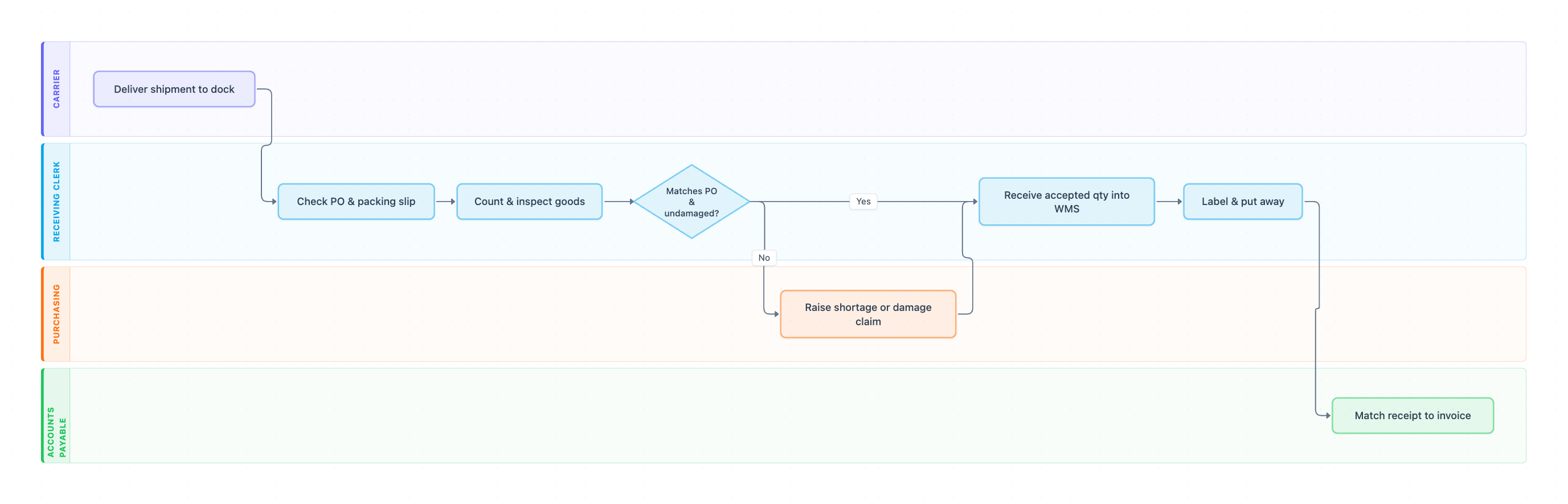
Example: Swimlane diagram for warehouse receiving: click to open it in the editor and change it.
Lanes and steps in order
- Deliver shipment to dock (Carrier): the carrier arrives with the goods and the bill of lading (BOL).
- Check PO & packing slip (Receiving Clerk): the clerk finds the purchase order and compares it with the packing slip.
- Count & inspect goods (Receiving Clerk): cartons and units are counted and checked for damage.
- Matches PO & undamaged? (Receiving Clerk, decision): Yes goes straight to receiving. No: the clerk writes the shortage or damage on the BOL before signing, takes photos and tells Purchasing.
- Raise shortage or damage claim (Purchasing): Purchasing asks the supplier for a credit or replacement.
- Receive accepted qty into WMS (Receiving Clerk): the accepted quantity is received against the PO.
- Label & put away (Receiving Clerk): goods are labeled and moved to their locations.
- Match receipt to invoice (Accounts Payable): AP matches the receipt, PO and invoice before paying.
Hand-offs and decision points
The decision happens before the clerk signs the BOL. Once the BOL is signed clean, it is much harder to claim for shortages or damage from the carrier or supplier. Receiving only the accepted quantity means the WMS, the PO and the invoice all show the same numbers for AP.
Where this process usually slows down
- Check PO & packing slip: deliveries arrive with no PO number. Ask suppliers to print it on every packing slip.
- Count & inspect goods: peak delivery times overload the dock. Book delivery appointments.
- Label & put away: goods sit on the dock after receiving. Set a put-away target that suits your volume.
How to adapt it for your company
- Add a quality inspection lane for goods that need testing before stock is released.
- Add a cross-docking path for goods that ship out again the same day.
- Add a returns-to-vendor path for rejected items.
- Add lot numbers or expiry dates at Receive accepted qty into WMS for food or pharmaceuticals.
Tip: Write the exact shortage or damage on the BOL and take photos before the driver leaves. A signature on a clean BOL usually ends the claim.
Standard operating procedure
Purpose: Receive only what was ordered, record it accurately and put it away fast, so stock and invoices match.
Scope: Starts when a carrier delivers to the dock. Ends when the goods are put away and the receipt is matched to the invoice.
Roles
- Carrier: Delivers the shipment and the bill of lading (BOL).
- Receiving Clerk: Checks, counts, inspects, receives and puts away goods.
- Purchasing: Raises claims with the supplier.
- Accounts Payable: Matches the receipt to the supplier invoice.
Procedure
- Carrier: Deliver the shipment to the dock with the BOL.
- Receiving Clerk: Find the purchase order and check the packing slip against it before signing anything.
- Receiving Clerk: Count the cartons and units, and inspect for damage.
- Receiving Clerk: If anything is short or damaged, note it on the BOL before signing, take photos and tell Purchasing.
- Purchasing: Raise a claim with the supplier for a credit or replacement within the supplier's claim window.
- Receiving Clerk: Receive the accepted quantity into the WMS against the PO the same day.
- Receiving Clerk: Label the goods and put them away in their assigned locations.
- Accounts Payable: Match the receipt to the supplier invoice and the PO before paying.
Process owner: Warehouse Manager
Turn this into a full SOP with AI →
Frequently asked questions
What are the steps in the warehouse receiving process?
Check the delivery against the purchase order and packing slip, count and inspect the goods, note any shortage or damage on the bill of lading, receive the accepted quantity into the WMS, put it away, and match the receipt to the invoice.
What should receiving do with damaged goods?
Note the damage on the bill of lading before signing, take photos, keep the damaged items separate, and tell purchasing so they can raise a claim with the supplier or carrier.
What is a 3-way match in receiving?
Accounts payable compares the purchase order, the receiving record and the supplier invoice, and pays only when quantities and prices agree.
Make your own swimlane diagram with AI →